· Nicholas Nadeau · Startup · 9 min read
What Got Me Through 2025: A Founder's Toolkit for the Zero-to-One Year
The tools, podcasts, and unexpected things that kept me sane and shipping during Onix's zero-to-one year.
The Setup
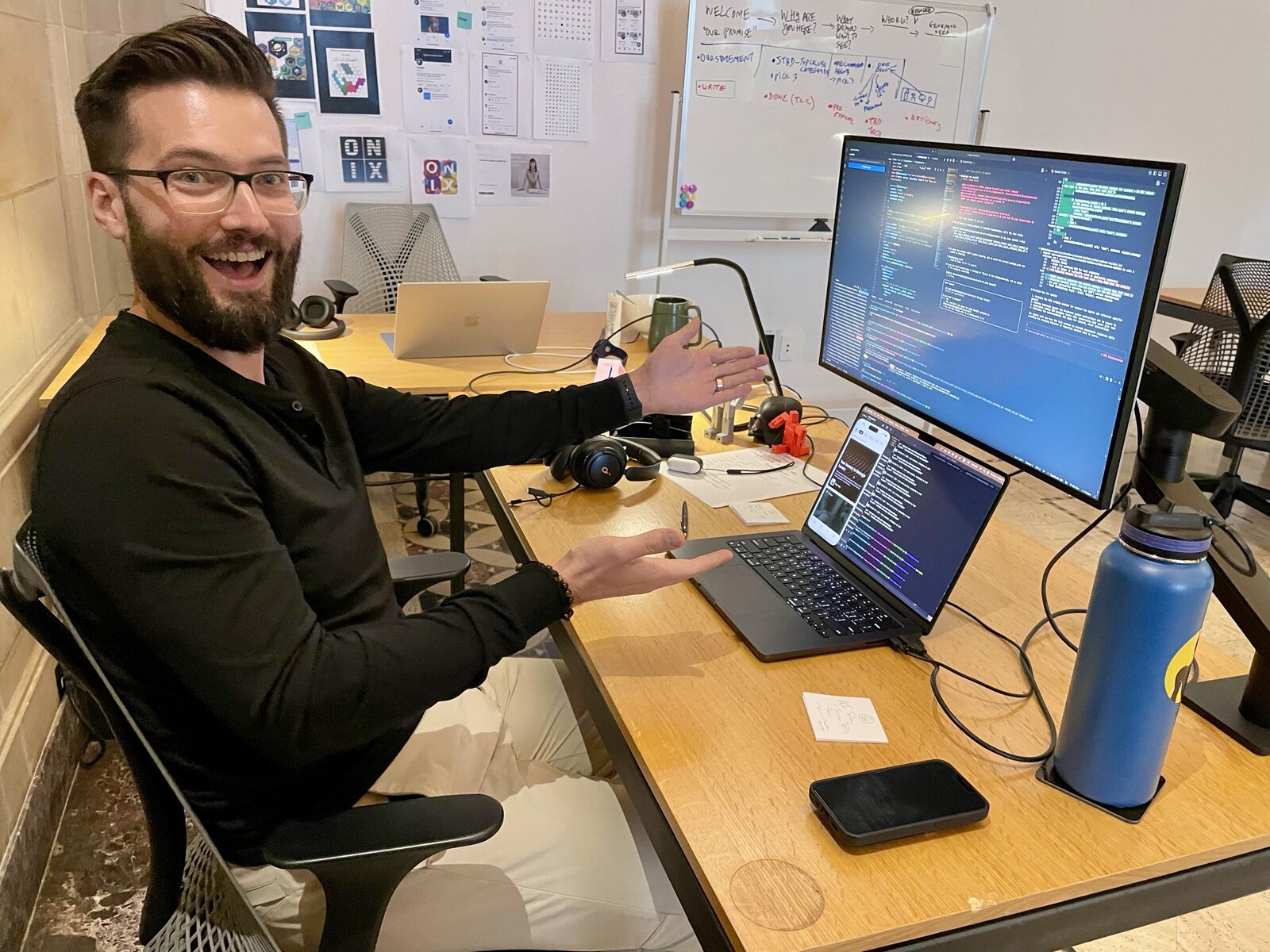
At the start of 2025, David and I started building Onix.
For most of the year it was just the two of us. Me building all the technology. David running all the go-to-market. It’s only in the past couple months that we hired our team and built out an office in Old Montreal.
This was also the year AI went from impressive to indispensable. The year of agents. The year that proved Andrej Karpathy right when he said English is the hottest new programming language. He called it two years ago.
Here’s what got me through it. The tools, the podcasts, the unexpected things that kept me sane and shipping.
The Stack That Shipped Onix
Claude Code: The Clear Winner
I started the year as a big Roo Code fan. Throughout 2025 I tried basically everything under the sun. By December? Claude Code is the absolute winner and it’s not even close.
The fact that I can now use it on mobile is a game changer. Ideas don’t wait for you to be at your desk. Being able to move from thought to code to shipped feature without friction is exactly the kind of workflow that lets a two-person team compete with companies ten times their size.
I still love writing code by hand, but you’d be missing out not to explore what’s possible now.
Linear: Making Me Hate My Jira Years
I spent years using Jira. Years. And now I look back at that time with genuine frustration because Linear showed me what project management could actually feel like.
The synchronization is seamless. The quick access menus are intuitive. The command menu is beautifully designed. Everything is snappy. It’s the developer experience I didn’t know I was missing. If you’re still on Jira and you haven’t tried Linear, do yourself a favor. You’ll wonder why you waited so long.
The Linear Slack bot deserves special mention here. It’s a phenomenal way to reduce friction and democratize access to triaging and submitting issues for the whole team. People can work right where they already are. No context switching. No opening another app. Just get the thought captured and move on.
Raycast: The Mac Experience I Needed
Being back on a MacBook Pro this year meant rediscovering Raycast. It’s become the command center for everything. Quick actions, clipboard history, window management, snippets. All the little things that add up to hours saved over the course of a year.
The M4 Max MacBook Pro: A Genuine 10X
I don’t say this lightly. This laptop is the best piece of hardware I’ve ever owned.
I’ve taken eight hour flights doing nonstop product development and landed with battery to spare. Eight hours. Of actual work. That’s not a spec sheet claim. That’s my lived experience building Onix at 35,000 feet.
For a founder in zero-to-one mode, where every productive hour matters, this machine has been a genuine multiplier. Not a marginal improvement. A real step change in what I can get done.
The Voices in My Ear
2025 was also the year I ran a half marathon. Which meant a lot of hours on the road with nothing but my thoughts and whatever was playing in my earbuds.
I’ve been listening to most of these podcasts for years, but this year they hit differently. Here are the ones that shaped my thinking in 2025.
Acquired
Yes, I know it’s trendy to say you love Acquired right now. I don’t care. It’s earned the hype.
What Ben and David do so well is break down companies into their critical components and show how even the smallest decisions in mission and vision create echoes across everything. Operations. Product. Customer relationships. Culture. Everything connects.
As a founder, this perspective is invaluable. You start to see how the choices you’re making today will ripple through your company for years. It makes you more intentional.
Darknet Diaries and Malicious Life
If you’re a technical founder, you’re probably not paranoid enough about security.
These two shows break down real attacks, real breaches, real consequences. In this era of AI, MCP, agents accessing everything, and data flowing in directions we don’t fully control, the lessons land harder than ever.
We’re building Onix with privacy at the core. These shows constantly remind me why that matters and what’s at stake when companies get it wrong.
Hard Fork
Every Friday. Reliably quirky. Kevin and Casey have this ability to make the week’s tech news feel like a conversation with smart friends who happen to know everything. It’s how I decompress at the end of the week while still staying sharp on what’s happening in the industry.
Twenty Thousand Hertz and 99% Invisible
I love people who go deep on their craft.
Twenty Thousand Hertz does this with sound design. 99% Invisible does it with the physical world. Both shows train you to see (and hear) the invisible decisions that shape user experience. As someone building products, this design thinking lens is something I try to bring into everything we create.
Plain English, Freakonomics, and Search Engine
We don’t take enough time anymore to think through problems in longer form context. Everything is hot takes and quick reactions.
Plain English, Freakonomics, and Search Engine all force you to slow down and actually understand how systems work. Why incentives matter. How to think through second and third order effects. Search Engine scratches a slightly different itch with quirkier questions.
The Books That Opened My Mind
These days I exclusively read science fiction in my spare time. It helps me think outside the box. Sci-fi writers are basically prophets.
Neal Stephenson’s Cryptonomicon basically predicted cryptocurrency. Margaret Atwood’s MaddAddam trilogy reads like a reflection of our split socioeconomic society and the dangers of uncontrolled tech. Seveneves was a rollercoaster and a reminder of what’s possible when society works together for a higher collective purpose.
But the series I fell in love with this year was Expeditionary Force. The AI character Skippy is something special. He’s a true ambient AI, sarcastic and brilliant, and the relationship between him and the human crew is a glimpse of the human-AI collaborations and relationships that are coming. It’s the kind of future I want to build toward.
The Unexpected Stuff
Not everything that worked for me this year fits neatly into “productivity tools” or “business podcasts.” Some of the most important things were the weird ones.
The Half Marathon
I mentioned the training earlier, but I want to be clear: deciding to run a half marathon wasn’t just about fitness. It was about having something completely outside of Onix that demanded consistency and discipline.
Building a company can consume everything if you let it. Having a physical goal with a fixed deadline forced me to protect time for myself. To get outside. To prove I could do something hard that had nothing to do with code or customers.
The long runs also became this incredible thinking time. Some of my best product insights came around kilometer 15 when my conscious mind had given up and something deeper took over.
Elden Ring
People might not know this about me, but I’m a big gamer. Haven’t played competitive multiplayer games in a long time, especially since having kids. I’m very much a patient gamer these days.
This year I replayed Elden Ring on New Game Plus and went through the Shadow of the Erdtree expansion. It was perfect for where I was mentally.
There’s something humbling about getting your ass handed to you over and over again. You die. You learn. You try again. Eventually you figure it out and the victory feels earned.
Founding a company is the same loop, honestly. The progression structure in Elden Ring, where every small win feels meaningful even when the overall challenge is massive, mirrors the founder experience in ways I didn’t expect.
NotebookLM
This one surprised me with how useful it became.
I have this habit of saving URLs and articles with good intentions of reading them later. “Later” rarely comes. NotebookLM let me dump all of that into a format I could listen to while running or working out.
Suddenly all that saved content became actual consumed content. It’s like having a continuous learning engine running in the background of my life. For someone who genuinely enjoys learning, this was a revelation.
Apple Notes and Apple Reminders
Here’s my controversial take: the defaults are good enough.
I’m fully in the Apple ecosystem. I’ve tried the fancy note taking apps. The complex systems. The second brains and Zettelkastens and whatever else people are building.
But honestly? Apple Notes and Apple Reminders just work. When I’m out on a run and have an idea, I can just tell Siri to capture it. No friction. No syncing issues. No wondering which app I put something in.
Simple systems that work beat complex systems that theoretically work better. Every time.
New York Times Games and Cooking
The NYT app, especially Games and Cooking, became a daily ritual. High quality. Beautifully designed. Straight to the point.
There’s something to be said for products that respect your time while still delivering real value. It’s something I think about when we’re building Onix. How do we make something people actually want to come back to?
The Thread That Connects Everything
Looking back at this list, there’s a pattern I didn’t fully see until I wrote it all down.
Everything that worked for me this year was about removing friction.
Claude Code removes the friction between idea and implementation. Linear removes the friction between thinking “this should be a task” and it becoming a task. Apple Notes removes the friction between having a thought and capturing it. NotebookLM removes the friction between saving content and actually consuming it. The M4 Max removes the friction of battery anxiety and performance limitations.
Even the podcasts. They remove the friction of learning. Turn dead time into growth time.
English really is the hottest programming language now. And what that means practically is that the gap between intent and execution is collapsing. The people who will win are the ones who remove every unnecessary step between “I want this to exist” and “this exists.”
That’s what we’re trying to build with Onix. That’s the philosophy behind every tool choice, every workflow decision, every product feature.
Remove the friction. Get back to what actually matters. Ship incredible value to customers. Build things that make a real difference in people’s lives.
What Actually Got Me Through
But if I’m being honest, none of this matters without the people waiting for me at home.

I’m a dad of two young boys. Everything I do is for them. The late nights, the early mornings, the relentless push to ship something meaningful.
We have a rare opportunity right now. AI can be a collaborator and a companion, or it can become another tool for exploitation. I want my kids to inherit a future where technology empowers people, not extracts from them. That’s what we’re building with Onix. That’s what gets me out of bed.
These are the tools that helped me ship Onix this year.
Here’s to 2026.